Rhetoric Always Finds a Way: Sam Leith on Persuasion in the Digital Age
8 May 2026
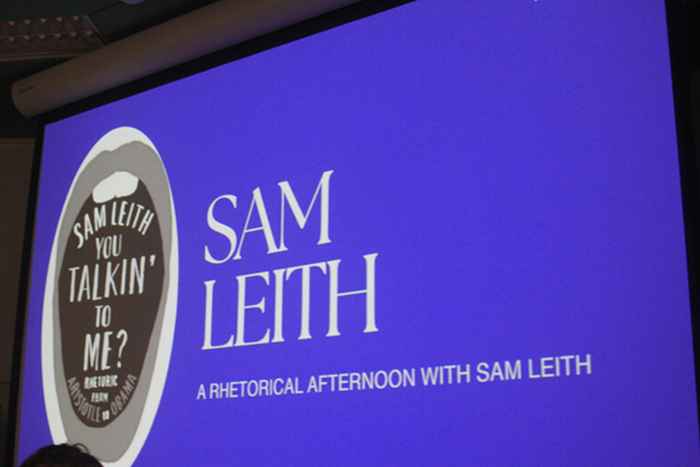
As a child in a family of authors, Sam tells us that when he was a kid he used to hide behind the curtains of his family home with a novel, painting a familiar image to many English-literature students. The image of Sam as a self-proclaimed ‘’nerdy kid’’ translates into the down-to-earth, humble person we had the opportunity to interview. He humorously admits that he struggles to finish a project without a deadline (and promise of payment, he jokingly adds) yet is able to formulate witty responses and sharp critiques. After reading You Talking to Me?, it should be of no surprise to readers that Sam is not afraid to speak plainly, which becomes even more evident throughout the interview.
Rhetoric in the digital age
When asked about rhetoric within the current digital age, Sam sarcastically states that he is ‘’kind of against AI’’, eliciting laughter from the audience. He discusses his concerns about the use of rhetoric within the 21st century, equal to ideas from his novel. To further explore and clarify rhetoric within this digital age, Sam was asked to take a look at and respond to a number of orators at work, beginning with Donald Trump.
After watching a short clip of Trump’s speech, Sam explains that he makes use of the rhetorical trope ‘’apostrophe’’ in order to change his addressee. Even though Trump actively addresses the members of the Iranian Revolutionary Guard, Sam questions whether the Iranians are Trump’s true audience. He discusses how the invention of radio, television, and the internet has massively expanded the range of audiences that can be reached by a speech beyond those physically present. ‘’The primal rhetorical situation is you don’t have media (…) The only people that can hear the speech, and take it in, and remember it are in earshot.’’
Rhetoric as a powerful tool
The importance of rhetorical strategies becomes further evident in other examples discussed in the interview. For example, when one of the interviewers mentions Mark Rutte’s prominent Dutch accent with a grimace, Sam immediately steps in to defend him. He explains how many orators purposefully change their accent in order to strengthen their ethos appeal and how Mark’s Dutch accent may, to contrary belief, be advantageous, for example within a NATO setting. Furthermore, Greta Thunberg, similarly to Trump, makes frequent use of the rhetorical trope anaphora. When asked how this influences Greta’s appeal to the audience, Sam argues that it works in her favour. ‘’Even though it is a structured speech, there’s this feeling like she’s trembling on the edge (…) You can’t really fake that.’’
After the interview and question round, it is clear that Sam’s research into rhetoric has resulted in a broad and critical understanding of the subject within both historical and digital contexts. Even though each orator discussed makes use of rhetoric in a different manner, it is evidently a powerful tool which can be used to a speaker’s advantage. While Sam’s passion for rhetoric is evident to both attendees of the interview and readers of his book, the concern he raises is equally striking: ‘’Rhetoric finds a way. Rhetoric always finds a way.’’