ACLC Seminar | Johan van der Auwera
- Date
- 22 May 2026
- Time
- 16:00 -17:00
- Location
- P.C. Hoofthuis
- Room
- 1.05
Abstract
Semantic map models have shown their value in the analysis of the synchronic variation in the use of both grammatical and lexical markers. Of these models, the ‘classical’ ones have also shown their value in the analysis of diachronic change (see e.g. Georgakopoulos & Polis 2018). In this presentation I will revisit what is probably the most influential classical map to date, viz. the indefiniteness map presented by Haspelmath (1997). The map embodies a strong and falsifiable hypothesis about the indefinite pronouns of the world’s languages. Synchronically: if any indefinite pronoun in any language has more than two functions, these functions have to be connected to each other, shown with lines on the map. This is illustrated for English somebody, anybody and nobody in Figure 1.
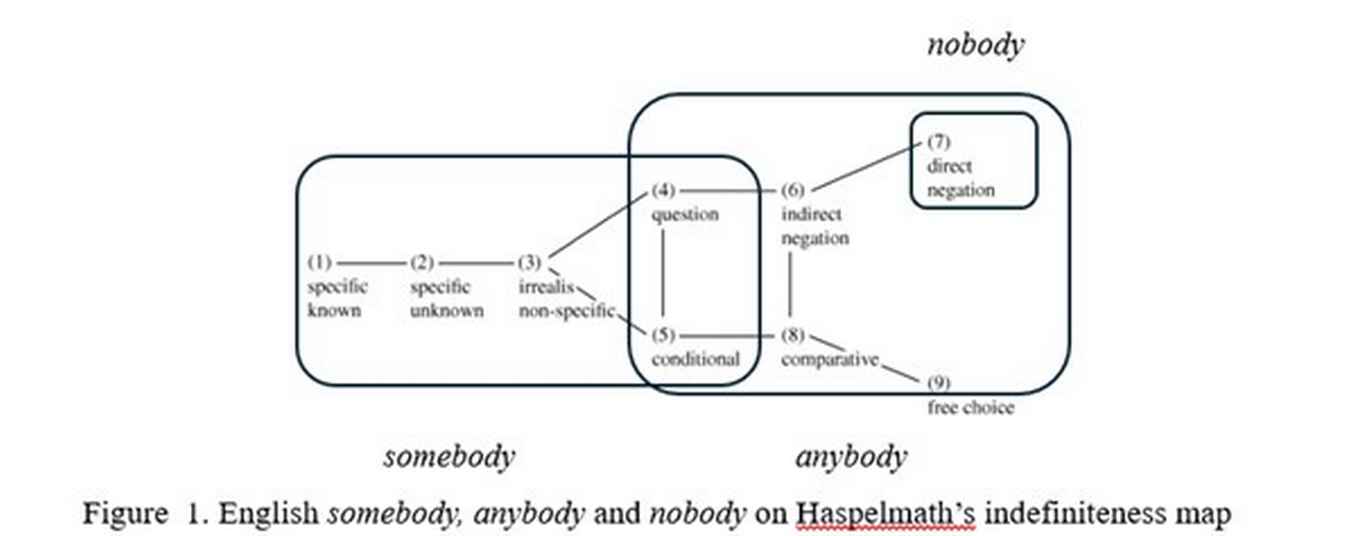
Diachronically: if any indefinite pronoun in a any language acquires a new function, this will have to be connected to an old function. French quelque, for instance has been claimed to have started from the bottom right and to have reached the ‘specific known’ function on the left.
The impact of the hypothesis has been exceptional, much of it remains valid, even though there have been proposals to improve it, some along lines that Haspelmath (1997) himself suggested.
In this presentation I will also suggest improvements. I will argue that it is possible and useful to make the map reflect both the meanings of the indefinite pronouns by themselves and the meanings that result from the interaction of these inherent meanings with the context. This will be shown to imply that the map points have to be split. I will show this for direct negation, conditionals and questions. The specific function is already split in Haspelmath but I will argue that we should split it more. I will also argue that so-called ‘anti-depreciative’ uses, such as shown in (1), can be positioned on the map and I will plead for a notion of ‘irrealis’, which functions in a three-way constellation with ‘realis’ and ‘potentialis’.
(1) I don’t drink any Chardonnay. I only drink a Chevalier-Montrachet.
References
Georgakopoulos, Thanasis & Stéphane Polis. 2018. The semantic map model: state of the art and future avenues for linguistic research, Language and Linguistics Compass 12(2). e12250. https://doi.org/10.1111/lnc3.12270
Haspelmath, Martin. 1997. Indefinite pronouns. Oxford: Oxford University Press.